
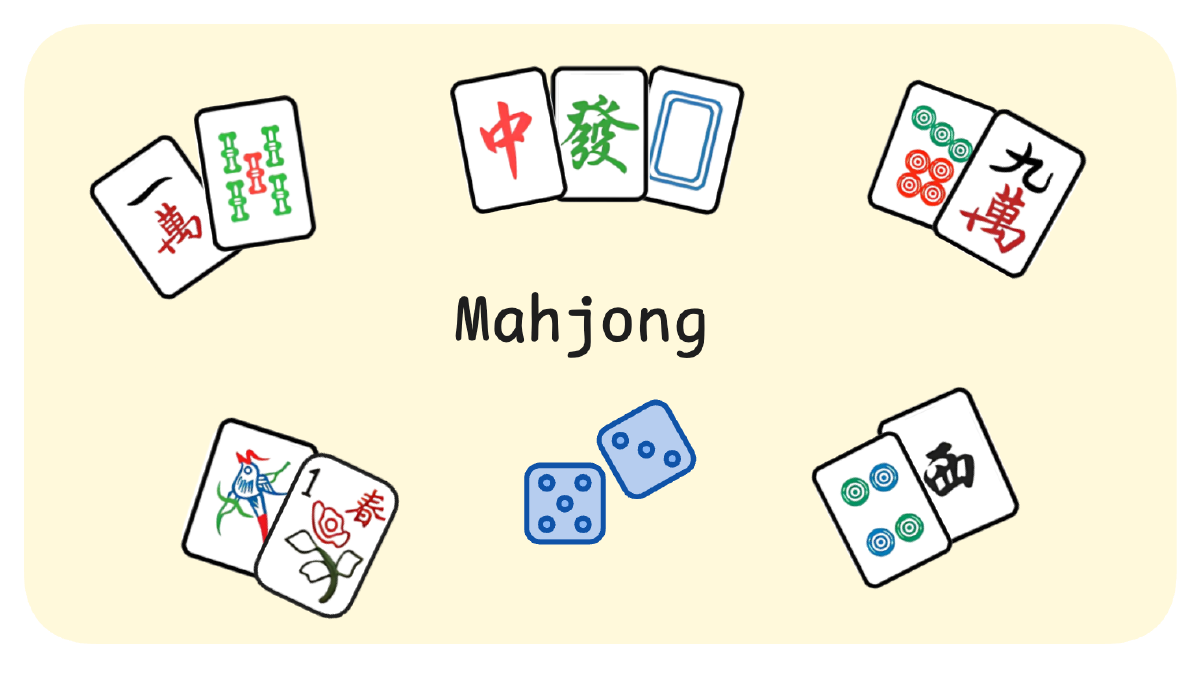


Download Mahjong Rulebook (PDF)Download Cheat Sheet (PDF)
1. INTRODUCTION#
2. EQUIPMENT & TILE TYPES#
Total Tiles: 144#
Suited Tiles – 108 Tiles#
- Circles (Dots): 1–9 (4 of each)

- Bamboo (Sticks): 1–9 (4 of each)

- Numbers (Characters): 1–9 (4 of each)

Honor Tiles – 28 Tiles#
- Winds: East, South, West, North (4 of each)

- Dragons: Red, Green, White (4 of each)

Bonus Tiles – 8 Tiles (Optional)#
- 2 sets of 4 Flowers

- Serves a very different function in the game mechanics
3. GAME SETUP#
1. Determine Seating#
- Prepare the 4 wind tiles: 東 (East), 南 (South), 西 (West), 北 (North).
- Shuffle Wind tiles face down.
- Each player draws one tile.
- Player with East becomes the dealer.
- Seating proceeds anti-clockwise from East → South → West → North.
In HK-style, play and tile-taking always proceed anti-clockwise.
2. Build the Walls#

- Each player builds a wall of 18 tiles long and 2 tiles high.
- Push all four walls together to form a square.

3. Roll the Dice & Break the Wall#
- The East player rolls 2 dice.

- Count clockwise starting from East.
- Go to the wall of the player in that direction.

- Break the wall after that number of stacks (e.g., if roll is 9, count from the right and break after the 9th stack.)

Example: If the dealer rolls a 9, count 9 stacks clockwise, then break the wall after the 9th stack, drawing from the 10th.
4. Deal the Tiles#
Tiles are taken clockwise starting from the dealer (East).
Each player initially gets 13 tiles, but the dealer takes 14 (and discards 1 to start).
Standard deal pattern is in rounds:
- Each player takes 4 tiles × 3 rounds (12 tiles).

- Dealer takes 1 extra tile (14 total).
- Then each takes 1 tile (for 13 total).
- Each player takes 4 tiles × 3 rounds (12 tiles).
5. Replace Bonus Tiles (Optional)#
- Reveal Flower or Season tiles and draw replacements from the wall’s end.
6. Determine Round Wind (Optional)#
What is Round Wind?#
- In mahjong, the round wind is a key concept that helps track the game’s progression and affects scoring. It changes as the game moves through rounds and determines who is the prevailing wind at any time.
- The round wind is the dominant wind for the current round.
- There are four round winds, in this order:
- East Round
- South Round
- West Round
- North Round
How Round Wind Affects the Game#
- Scoring Bonus: If your seat wind (your position) matches the round wind, you may get bonus points for certain combinations (like a Pong of the round wind).
How the Round Wind Moves#
- Start in the East Round
- The dealer (East seat) starts the game.
- Play continues anti-clockwise.
- Dealer Rules
- If the dealer wins or there is a draw, the dealer keeps their seat.
- If the dealer loses, the East seat moves to the next player (anti-clockwise).
- Changing Round Wind
- After every 4 players have taken the dealer position, the round wind advances.
- Example:
- Let’s say players A → B → C → D take the East seat (dealer) in order
- After all 4 have been East once, the round changes. Round Wind changes from East to South.
- New round begins again with player A as dealer (East seat), but now in South Round
4. PLAYING THE GAME#
- The game starts with East discarding 1 tile.
- Turns go anti-clockwise.
- Each turn:
- Draw 1 tile from the wall OR Optionally claim a discard to form a set
- Discard one tile face-up.
5. THREE TYPES OF SETS#
Triplets of 3 consecutive tiles (Seung)#

- A straight sequence of three consecutive tiles in the same suit
- This applies to the suited tiles (Circles, Bamboo, Numbers) ONLY.
- Example: 4–5–6 Bamboo.
- Can only be claimed from the player to your left.
3 of a Kind (Pong)#

- A set of three identical tiles.
- This applies to both suited tiles AND honor tiles.
- Call from any player.
4 of a Kind (Gong/Kong)#

- A set of four identical tiles.
- This applies to both suited tiles AND honor tiles.
- When you declare a Kong, draw 1 replacement tile from the end of the wall.
- The 4th tile doesn’t count in the total no. of winning tiles.
Bonus: The Pair (Eyes)#

- Not a set, but you also need one pair of identical tiles to complete a standard hand.
- Example: two 3-Circles
6. SIX WAYS TO BUILD YOUR HAND#
1. Draw (from the wall)#
- Draw the next tile from the wall when it’s your turn.
- Decide whether you want to keep this tile.
- Every time you draw a tile, remember to discard one tile face up.
- Always make sure you have 13 tiles in total. You should only have 14 tiles when you win the game.
2. Pong/ 3 of a Kind (from other’s discard)#
- Immediately after someone discards a tile, you can shout Pong! and take that tile.
- For example, if you have a pair of Bamboo 1 in your hand, you can take another Bamboo 1 from the discard pile to complete the 3 of a kind set.
- After you pong, you have to reveal the identical triplets to prove that you can take it.
- The triplets are set and cannot be changed throughout the game.
- Now discard a tile.
3. Seung/ 3 Consecutive (from other’s discard)#
- You can only Seung from the player on your left (previous player), not anyone else.
- You can take a discarded tile from them to complete your consecutive set of the same suit.
- You have to show the completed triplets, just like after a Pong.
- Now, the triplets are set and cannot be changed throughout the game.
- Now discard a tile.
4. Gong/ 4 of a Kind (draw from wall’s end)#
Exposed Gong
Formed using a discarded tile.
- You already have three identical tiles (a Pong).
- Another player discards the fourth matching tile.
- You declare a Gong, reveal all four tiles, and place them face up.
- Draw one tile from the end of the wall to maintain 13 in hand.
Concealed Gong
Formed with all four tiles drawn yourself, not using any discards.
- You have four identical tiles in your hand.
- Declare “Gong,” reveal them face-down.
- This remains a concealed Gong, even though declared.
- Draw one tile from the end of the wall.
Extended Gong
Upgrade a Pong you already have on the table into a Kong when you draw the fourth tile.
- You already have an exposed Pong on the table.
- Later, you draw the fourth matching tile.
- You add the tile to your Pong, declare a Kong, and draw a tile from the end of the wall.
| Type of Kong | How It’s Formed | Hidden? | Draw Bonus Tile? | Can Be Robbed? |
|---|---|---|---|---|
| Exposed Gong | Add to a Pong with a discarded tile | ❌ | ✅ | ❌ |
| Concealed Gong | Four of a kind all from self-drawn tiles | ✅ | ✅ | ❌ |
| Add-on Gong | Add 4th tile to an already exposed Pong | ❌ | ✅ | ✅ |
5. Replace Flower (draw from wall’s end)#
- When you draw a flower, you display it.
- It allows you to draw a tile from the end of the wall.
- Now discard a tile.
6. Winning (Self-drawn or from other’s discard)#
- You can win by Self-Draw (drawing your own winning tile from the wall).
- OR Winning on Discard (claiming another’s discard).
- This is the last tile you will need to complete your hand.
- In the event where multiple players want the same tile, Pong takes precedence over Seung (unless it is the winning tile!)
- You only need to display when you take someone else’s discard.
- You can only Pong, Seung or Gong immediately after it’s been discarded. You need to be fast!
- Doing this will cause some player to skip as it becomes your turn!
7. WINNING A HAND#
1. Make a Complete Hand#
A standard winning hand consists of:
4 Sets (Pong, Seung, or Gong) + 1 Pair (Eyes)
Total: 14 tiles at the time of winning Note that the 4th Gong tile doesn’t count in the total no. of winning tiles
2. Have 14 Tiles at Win#
- You always hold 13 tiles, and win by drawing or claiming the 14th.
- You can win by:
- Drawing a tile
- Claiming a discard
3. Declare Win#
When your hand meets the criteria:
- Say Sig!
- Reveal your hand for scoring.
8. SCORING SYSTEM (FAN)#
- In Hong Kong Mahjong, scoring is based on Fan (番).
- Most tables require a minimum of 3 Fan to win, unless you’re playing a house rule that allows “any winning hand.”
How Fan Works#
- Fan (番) is the unit of scoring, and the total fan determines the payout.
- Fan are earned by combinations in your hand and win conditions.
Low Scoring Combinations (1 or 2 Fan)#
| COMBINATION | DESCRIPTION | FAN |
|---|---|---|
| Chicken Hand | Hand with no value | 0 |
| Pong/ Gong of Dragon tiles | A Pong (3 of a kind) or Kong (4 of a kind) of any Dragon Tile including Red, Green and White Dragons. | 1 |
| Pong/ Gong of player’s seat wind | A Pong/Kong of the Wind tile that matches your seat: East, South, West, or North. | 1 |
| Pong/ Gong of round wind | A Pong/Kong of the Wind tile that matches the current round: East Round → East wind tiles count | 1 |
| Flower matching your seat | You draw a Flower tile that corresponds to your seat wind. i.e. East = 1; South = 2; West = 3; North = 4 | 1 |
| Self-draw win | You draw the winning tile yourself instead of winning from another player’s discard. | 1 |
| Winning by last tile | Win on the last tile in the wall or last discard of the game | 1 |
| All Seung/ 3 consecutive triplets | A hand made entirely of Seung (sequences of 3 suited tiles), plus a pair. There is no honor tiles, no Gongs, no Pongs. The triplets can be in different suits. Example: | 1 |
| Winning by robbing a Kong | You win by “robbing” another player’s attempt to upgrade a Pong to a Kong using a tile you need to complete your hand. | 1 |
| Concealed hand | You keep your hand completely concealed, then win by someone else’s discard. | 1 |
| No flowers in hand | If you win a hand without having drawn any flower tile, your hand is considered “no flower” | 1 |
| Win on replacement tile | Winning on the replacement tile drawn after declaring a kong. | 1 |
| All Flowers | Hand contains all flower tiles. Implies Seat Flower. | 2 |
High Scoring Combinations (3+ Fan)#
Why 3 Fan Matters#
- In standard Hong Kong mahjong, you must have at least 3 fan to win a hand.
- So 3-fan hands are often your baseline goal, and it’s crucial to know how to build them efficiently.
| COMBINATION | DESCRIPTION | FAN |
|---|---|---|
| All Pongs 對對胡 | A winning hand made entirely of 4 Pongs/ Gongs and 1 pair. No sequences allowed. Can be concealed or exposed. Often combined with Wind or Dragon tiles for extra fan. Pongs can be in different suits. | 3 |
| Half Flush (One suit + honors) 混一色 | A hand consisting of tiles from only one suit (Circles, Numbers or Bamboo), plus any no. of honor tiles (Winds or Dragons). Often a good way to reach 3 fan when combining with other bonuses | 3 |
| Little Three Dragons 小三元 | Hand of two dragon pongs and a pair of the third dragon. | 5 |
| Little Four Winds 小四喜 | Hand of three winds pongs and a pair of the 4th wind. | 6 |
| Full Flush 清一色 | Hand consists only of suit tiles of the same suit. No honor tiles, not mixed suits. | 7 |
| Big Three Dragons 大三元 | Hand has three dragon pongs/ gongs. | 8 |
| Big Four Winds 大四喜 | Hand has four Pongs of all Winds | 8 |
| All Honors 字一色 | Hand consists only of honor tiles. | 10 |
| Nine Gates 九子连环 | Concealed hand of 1112345678999 in one suit and winning on any tile of the same suit. | 10 |
| All Terminals 全么九 | Hand consists only of 1s and 9s of any suits. | 10 |
| Thirteen Orphans 十三么 | Hand made of 1 and 9 of each suit, all honor tiles, and one duplicate of any of the 13 tiles above to form a pair. This is the highest scoring and most iconic win. | 13/ Limit |
| All Gongs 十八罗汉 | Hand has four Gongs and a pair. | 13/ Limit |
| Blessing of Heaven 天糊 | East wins instantly with initial 14-tile deal, before any turns are taken. | 13/ Limit |
| Blessing of the Earth 地糊 | Non-east player wins on East’s first discard. | 13/ Limit |
Limit Hands = Instant win at highest possible payout.
Example Scoring Breakdown#
- Concealed Hand → 1 Fan
- Self-Draw → 1 Fan
- Pong of Red Dragons → 1 Fan
- A pair of Seat Wind → 0 Fan
- Matching Flower → 1 Fan
Total = 4 Fan → Valid Winning Hand
9. BEGINNER MISTAKES & STRATEGIES#
Common Beginner Mistakes#
- Calling a tile from the wrong player for a Seung
- Declaring win with an invalid/ illegal hand
- Forgetting to draw a tile from the end of the wall after declaring a Kong or after taking a flower tile
- Holding more or fewer than 13 tiles
Basic Strategies for Beginners#
- Focus on One Suit
- Try to build most of your hand using Bamboo, Circles, or Numbers
- This opens the possibility for a Pure Suit (3 Fan) hand.
- Keep Options Open
- Don’t lock into one plan too early.
- If you’re building Pongs (three of a kind), keep your eyes open for possible Seung (three consecutive tiles) as well.
- Watch Discards Closely
- If many players discard a tile (e.g., 7 Bamboo), don’t hold on to yours hoping to complete a Seung or Pong.
- Defend in the Late Game
- If someone looks close to winning, discard safe tiles (tiles they’ve already discarded).
- Use Calls Carefully
- Pong and Gong calls help complete hands faster but reduce Fan due to exposing tiles.
- Keep sets hidden if aiming for a Concealed Hand (1 Fan).
11. GLOSSARY#
Basic Terms#
- Tile: The small rectangular pieces used to play Mahjong.
- Wall: The stacks of tiles players draw from at the start and during the game.
- Draw: Taking a tile from the wall.
- Discard: Placing a tile face up in front of you when you don’t want it.
Sets#
- Seung: A sequence of three consecutive numbers in the same suit (e.g., 4-5-6 Bamboo).
- Pong: Three identical tiles (e.g., three Red Dragons).
- Gong: Four identical tiles.
- Pair: Two identical tiles.
Special Tiles#
- Honor Tiles: Winds (East, South, West, North) and Dragons (Red, Green, White).
- Flower Tiles: Bonus tiles that give extra points, usually removed when drawn.
Game Phases#
- Round Wind: The current prevailing wind that affects scoring.
- Seat Wind: The wind assigned to each player’s seat.
- Ready Hand: When you’re one tile away from winning.
- Winning Tile: The tile that completes your winning hand.
- Self-Draw: Winning by drawing the winning tile yourself.
- Winning on Discard: Winning by claiming another player’s discard.
Winning Hands and Scoring#
- Fan: The unit for scoring, each fan multiplies your points.
- Limit Hand: A special rare hand with maximum score, like Thirteen Orphans or Heavenly Hand.
- Concealed Hand: A hand with no exposed tiles, often scores higher.
- Robbing the Kong: Winning by claiming a tile someone uses to upgrade a Pong to a Kong.
Common Actions#
- Pong Call: Claiming a discard to form a Pong.
- Seung Call: Claiming a discard from the player immediately before you to form a Seung.
- Gong Declaration: Announcing a Gong and drawing a replacement tile.
Others#
- End of the Wall: Reserved tiles used for replacement draws after Gongs or taking a flower tile.
- Discard Pile: The face-up discarded tiles.
- Breaker: The player who starts the round or deals.